


Ignite your interest in ignition
 19 March 2018
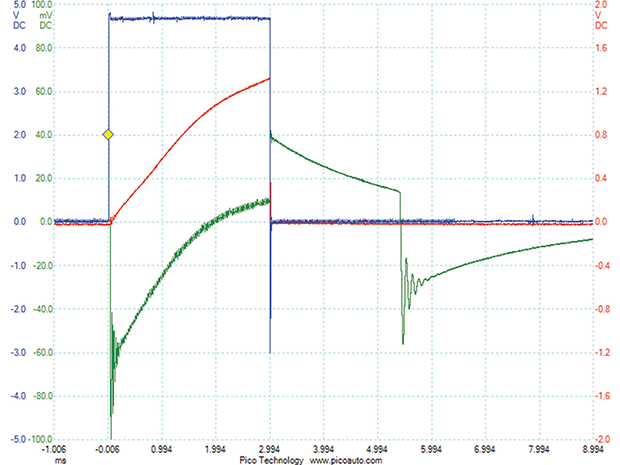
This month’s subject was prompted by a recent conversation with a colleague in Australia. The conversation included an invitation to a technical festival in October, where it was said that ignition would be one of the subjects of interest. Many years ago, when I began developing our training programme, ignition was a subject of primary concern when diagnosing gasoline
engine problems.
This is a complex subject often not fully understood and often overlooked. Its vital importance recently became apparent in our workshop, when we were presented with two Audi rs6 engine failures. One failure has yet to be investigated the other suffered piston failure due to combustion faults.
The increasing complexity of homogenous and stratified fuelling, split injection delivery and variable valve timing geometry has placed critical responsibility on ignition performance. Often within the diagnostic process there is no serial evidence of an ignition problem, or that what evidence is available is incomplete especially at the early stages of failure. The process has not changed in over 30 years; You must scope it.
Process overview
So here is an overview of the process. Firstly, you must understand that it requires a specific amount of energy to completely combust the air fuel charge. Ignition energy is measured in joules, our task it to ensure the energy is created and delivered correctly. The primary circuit bears the responsibility of energy creation with current profile as the focus of our measurement. The secondary circuit has the responsibility of delivery, our focus is burn time and slope profile.
I accept that both circuits have a shared responsibility at the point of induction where energy within the primary is transferred into the secondary. The physical challenge is the method of accessibility. With static or direct ignition it is often not possible to connect to the coil primary circuit, leaving the option of induction as the method of measurement. The primary will always have a power and switched ground, so current measurement using a suitable hall clamp is always possible.
Diagnostic observations
The four critical diagnostic observations in order of priority are:
Ignition burn time measured in milli-seconds with a range of 1-3ms depending on ignition type. Do not assume length of burn relates to energy value Primary current profile with a range of 3amps (points ignition) 20amps static ignition. Note the expression profile, it includes rise time and rate of collapse Coil ringing, this is the resonance at the end of the burn event it represents the small residual ignition energy returned in to the coil secondary winding Firing line voltage, this represents the value of electrical pressure in delivering the induced energy to the spark plug electrode it includes all components in the delivery process
You must also understand that the performance of the injector, cylinder turbulence, and mechanical efficiency forms part of the combustion process. Intake air temperature, pumping losses and fuel quality all affect the burn process. Let’s begin with the tool I distrust the most! Serial data is a good first look – there is some very useful information such as cylinder misfire count, ignition timing individual timing retard data, air intake temperature and exhaust temperatures. There may also be additional data on burn time and primary charge time, but I don’t trust or rely on it.
So, out with my Pico scope. Connectivity can be a challenge, over the years we have built our own probes, however, if the manufacturers can run a circuit there you can scope it. There is a simple logic process. Begin with burn time, look at the duration and slope it – It should be roughly parallel with the horizon.
A rising line confirms a difficult transition of energy across the electrode. Lean combustion, glazed plug, cylinder pressure, plug performance. Cylinder turbulence.
A falling slope represents the opposite condition; low cylinder pressure, fouled or shunting plug circuit, small plug gap. The burn profile should be relatively smooth, a turbulent burn path confirms difficult in cylinder conditions. It can and does point to injector fuel delivery problems especially if a sharp rise at the end of the burn time is present.
You may appreciate now just how vital scope evaluation is.
Primary current path confirms good power supply and the performance of the power transistor in its ability to switch and hold load to ground. Note the rise time characteristics and the off switch, under shoot here is a good indication. If you can, observe primary voltage. Note the slow rate on load, it’s the slow rise in voltage during coil charge time, a problem here will affect current flow so go for current first its easier to understand. Remember one of my core diagnostic rules; If it moves, gets hot, or applies a load measure current!
Coil ringing is the inverted energy returned into the coil secondary. With no path to ground, it gradually gets weaker, converting its energy to heat. Expect 2/3 rings in current systems. If the coil windings are compromised in any way a reduction in inductance will follow. The rings will disappear, ignition energy may still be present but a reduction in value will result. Be warned this condition will never be known if not scoped and critical engine failure often follows.
Firing line voltage can only be measured accurately in primary to be honest. Expect the following values:; Conventional rotating ignition 50v, wasted spark ignition 40v, direct ignition30v; Plus or minus 5 v on all values. The problem with exploring this with a coil probe is that the probe attenuation is not known, so its difficult to scale.
I hope this helps. It is a very complex subject , often neglected and overlooked.
Just before I go here is a challenge; How many information systems, VMs especially, don’t give these four vital statistics? So how do they know if there is a problem?