


A month in the life of a vehicle technician
 5 December 2023
Was the pressure getting to Frank when he got to work on a rough-running BMW 318i? He wants you to decide
Every day should be a school day. With the last month’s experience in the workshop providing a salutary example, I think we need to start with some ground rules.
I have lived with and advocated these rules over many years both in my personal repair technique and in all my years of diagnostic training. First, avoid taking on a repair task unless you have all the assets in place. Next, make sure you have a sound knowledge of the system and component with regards to its functionality. Make sure you have full current flow schematics, with test plan procedures, along with service updates and known bug fixes. It goes without saying that you need the tools required for both mechanical and electronic repair procedures You also need to be able to assess via accurate and reliable measurement values, with the ability, confidence and experience to carry them out.
Lastly, always reserve opinion and repair action with unconfirmed measurement values. I have chosen my words carefully here as I am pointing my finger at serial data. I have argued over the years regarding its unreliability even if it appears to conform with expected values.
I have experienced endless sensor error values especially with non-OE sensors, along with numerous wiring problems and even PCM internal faults. In keeping with this philosophy, I have in the past consistently and with great success relied on oscilloscope and gauge measurements.
So, what has changed? Why do I now find myself falling into my own bear trap. I agreed to take on a part time role in my son’s business, an independent garage with little or no diagnostic infrastructure. Working across a wide range of vehicle marques, add to this equation that it is almost impossible to access components, and my reluctant acceptance that serial data is increasingly the ONLY way to evaluate some if not most system functionality.
Assessment
Enter the BMW 318i, M40. The customer complaint was severe hesitation on acceleration cutting out and general rough running. By the time I had it in my shop there were no fault codes, so I began with some simple visual checks and an assessment of the battery condition.
The vehicle would crank attempt to start with little or no throttle response. Returning to a past life I removed the plugs to assess any combustion issues, I found them severely overtight, and what looked like carbon blow past on one coil. This observation was consistent with other evidence of poor workmanship. I added this consideration to my list of possibilities.
My first detailed assessment was undertaken using TOPDON serial platform. There appeared to be comprehensive system access with good data. By now, the vehicle would not run at all but did not display any DTCs. I wanted to ensure good ignition energy without getting too technical so removed a coil and with a new plug checked the spark across the electrode.
Fuel pressure
Next I examined fuel pressure. This is a high-pressure direct injection system with impossible access to the injectors or fuel rail without stripping out the PCM, wiring and inlet manifold. So here is mistake #3; I hope your keeping count. I chose to monitor low pressure priming and high-pressure values serially. The only available data, E3, was seriously lacking; Mistake # 4. Low pressure was a very, if not too healthy, 690KPA, 6.9 bar with high pressure reading 0.1 bar. I would normally expect priming around 4-6 bar.
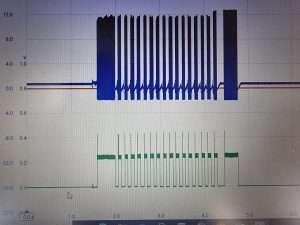
With high pressure pump failure, you would expect the same value as priming pressure. This is a linear pump action, driven from the camshaft, with inlet and exit ports controlled by a solenoid via the PCM. My thoughts were heading towards this perhaps being a control problem. With a closed inlet, this could account for the slightly elevated priming pressure. Out came my scope, and I could just reach the HP pump solenoid with some minimal swap out. Please refer to Fig.1. The PCM control was consistent with other known direct injection variants, utilising PWM control.
Satisfied with this confirmed value, I reflected on something interesting on the internet regarding this exact pump type failure. Apparently, if the pump was fitted with the CAM on full lift, it could bend or break the plunger or CAM follower. To rule this out I removed the HP pump and examined the two CAM lobes and plunger. Everything was okay.
Solid knowledge
At this point I was about to advise ordering a new pump. Maybe it was the £900 price tag or my guardian angel (experience) that directed me to confirm priming flow and pressure before taking the plunge on a new part.
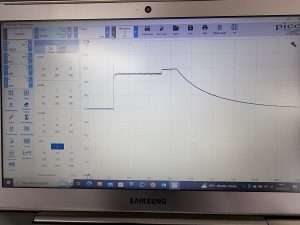
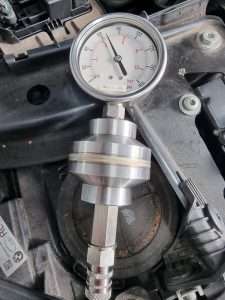
Out came my trusty hydraulic test gauge. In order to attach it safely, I interrupted the junction by the lower chassis rail. Cranking the vehicle, the gauge indicated zero pressure. This was strange, as the serial data indicated 6.9 bar. There it was in a nutshell. Did I lose my way, was I over cautious, or misled by inaccurate serial data? You decide I have already blamed my mistake on not following my own advice; Measure and verify always. A new in-tank pump was fitted. I also checked PCM control using my Pico and re-checked low pressure with the gauge at 4.5 bar. Serial data was still at 6.9 bar. Please refer to Fig.2, which shows PCM control of the low-pressure pump. Then look at Fig.3, which shows the gauge fitted to the priming circuit, and the actual pressure value.
The vehicle now started and ran, but with a slight uneven balance. New plugs were previously fitted, so I scoped the ignition profile confirming good spark burn time and primary current profile. Armed with this solid knowledge, I had no hesitation in advising a probable injector delivery issue. The customer agreed and following further and quite extensive swap-out time to reach the injectors, I was able to bench test and confirm that No.3 cylinder flow was down by almost 25%.
Following an ultrasonic clean in our ASNU bench, balance was restored and a very smooth engine response was presented to our customer. The labour alone was £1,500, but this is where we are and exemplifies my point at the start of this story; Get your ducks in a row or suffer the cost from your own pocket.