


Don’t let it slip
 13 April 2012
A RELATIVE rang me up recently to tell me that the clutch in his 2008 Astra CDTI had started to develop a squeaking, chattering noise from the clutch pedal and that it seemed to vibrate more than it ever had before. He then went on to say that he thought it was a misfirecausing the vibration issue and could he bring it over for me to look at and diagnose.
When the vehicle clattered onto our driveway, the noise was so loud I could hear it even before I had gone out of the workshop! On the first inspection of the car at idle, it was shaking and, when he put his foot on the clutch, the vibrating seemed to ease slightly but then the squeaking got louder.
I diagnosed that the dual mass flywheel (DMF) and clutch would need replacing and then called the main dealer. He quoted over 2,000 for parts and labour. A clutch noise that changed when you put your foot on the clutch used to mean a thrust bearing issue, or in some cases a clutch pack costing approximately 250
The dual mass flywheel is designed to give an improved driving experience for manual transmission vehicles; it absorbs the noise and reduces vibrations that are produced by the engine, clutch and transmission during acceleration and driving.
Not serviceable
The DMF is not a serviceable unit but a replacement part only because it is machined and balanced at the factory to enable it to work correctly. If it is damaged in any way, always replace the unit…never try to reface or re-skim as it will affect the balance of the unit. Always replace the flywheel retaining bolts and re-torque to the manufacturer’s specifications.
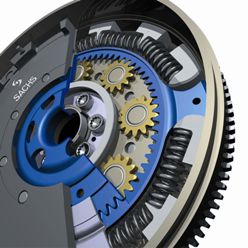
As regular readers of aftermarket will know, there are different types of dualmass flywheel; one version uses torsion springs and cushions, while a more expensive type incorporates planetary gearing to further smooth out the ride.
Like all moving parts on a vehicle, the DMF is a wear item that may eventually need replacement, just like a conventional clutch. High mileage or heavily worked vehicles that reach a second clutch change are recommended by firms such as ZF Services to have the DMF replaced at the same time.
Flywheel
The torsion spring and cushion type of the dual mass flywheel assembly is made up of two parts – a primary flywheel section which is connected to the crankshaft, which normally has the starter ring gear attached to it and the secondary flywheel section which will have the clutch bolted to it. The primary and secondary parts are connected via torsion springs and cushions between the two flywheels; there is also a friction ring that allows the primary and secondary flywheels to slip. This is designed to save the torsion springs when there is excessive engine torque load. The friction ring will wear out if the slip mode – excessive torque – is continuously applied. There is a centre ball bearing which carries the load of both flywheel sections.
As the vehicle mileage increases, the springs and dampening mechanism weaken so much that the movement between the primary and secondary flywheels becomes too excessive, creating vibration and noise from within the gearbox bell housing.
Allowing the drive plate of a conventional clutch to wear down to the rivets can cause flywheel scoring, which can also occur on the secondary flywheel of the DMF.
Excessive DMF oscillation may cause premature wear to the arc springs within the unit. This typically arises at very low engine speeds, driving in too high a gear, allowing the engine to idle for excessively long periods (e.g. to keep air conditioning running when parked) or frequent engine stalling. Other possible causes include misfiring due to ignition or fuel system faults, uneven compression pressures or vibration caused by worn powertrain components.
Starter for ten
I have known other issues with vehicles that will come into the workshop with a suspected starter motor issue. On its replacement it later returns with the same issue. However, on further inspection the iron filings from the dual mass flywheel were found to be damaging the starter motor.
There can also be issues with a non-start due to iron filings covering the crankshaft position sensor. Thiswill cause either a weak signal or none at all. You may also find that if the pick-up point is located on the secondary flywheel you could get a crankshaft position sensor
fault code logged in the engine ECU memory.
Overheating is normally caused to the secondary flywheel by riding the clutch pedal and allowing it to slip. On some types of Dual Mass Flywheels the excessive heat will make the damping lubricant leak from between the primary and secondary flywheels which will leave the springs and their seats to run dry. Overheating is identified by blue or straw-coloured heat damaged areas or cracks on the secondary flywheel.
This indicates a temperature rise some three times the maximum expected during normal DMF operation, generally caused by excessive clutch slip. The lubricating and damping grease within the DMF breaks down and becomes ineffective with excess heat, reducing vibration damping and causing internal parts to run dry and wear prematurely. Such loss of lubrication may lead to the destruction of these parts which then damage the housing.
If there is any evidence of grease leaking from the unit it should be replaced.
Examinethe circle of rivets around the hub area on the primary flywheel for further evidence of overheating. If there is a line of yellowing (overheating) joining these rivets, this indicates wear of the collar separating the two flywheelmasses, which could result in metal-to-metal contact. For an overheated DMF, replacement is once again the only option.