


DPF maintenance
 24 June 2014
Achieving the tough vehicle emissions levels under Euro 5 legislation requires a Diesel Particulate Filter (DPF) to be fitted to collect carbon soot particles generated from the combustion process in a diesel engine.
These particles are microscopic balls of carbon containing pure carbon at their core around which are deposits of different hydrocarbon compounds, metal oxides and sulphur, some of which are potentially hazardous to health.
DPFs, however, are prone to malfunctioning as a result of becoming blocked or full, particularly when the vehicle makes an excessive number of short journeys.
Types of regeneration
This will result in a fault code appearing (see list of typical DPF fault codes), such as P1471 – DPF regeneration not completed. When this happens the first response is to try running a regeneration of the filter to see if that solves the problem.
Forced regeneration is a simple procedure that can be carried out by a workshop and is usually needed because an active regeneration has not been successful during everyday driving by the driver. Depending on the type of diagnostic programme available this can either be a Static Regeneration or a Regeneration Run.
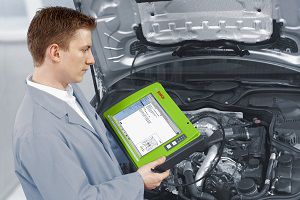
For a Regeneration Run the technician must select the programme on the KTS and take the vehicle for a drive at a moderate cruising speed for a suitable period of time, usually about 20 minutes. The KTS initiates the Regeneration Run and monitors the process throughout so a second person is required to operate the KTS while this is being performed.
Find out more
Bosch run a half day training course (VSD 36) for technicians who wish to effectively diagnose faults with Diesel Particulate Filters.
The course covers the design and function of a DPF, what the driver may experience with a blocked DPF, and what conditions might cause the DPF to block prematurely, giving a technician background information on DPFs before covering the different types of regeneration strategies.
http://www.boschautoparts.co.uk/training
Typical DPF fault codes:
P1471Diesel particulate filter (bank 1) regeneration not completed
P2002 Diesel particulate filter (bank 1) efficiency below threshold
P2003 Diesel particulate filter (bank 1) particulate mass too high
P242F Diesel particulate filter (bank 1) regeneration not active
P244A Particulate filter differential pressure too low
P224B Particulate filter differential pressure too high
P2452 Particulate filter differential pressure sensor malfunction
P2453 Diesel particulate filter differential pressure sensor malfunction
P2454 Diesel particulate filter differential pressure sensor voltage too low
P2455 Diesel particulate filter differential pressure sensor malfunction
P2458 Particulate filter regeneration maximum regeneration time exceeded
P2459 Particulate filter regeneration, regeneration frequency implausible
Related content: