


No Smoking!
 22 May 2018
There’s nothing I love more than picking up an automotive magazine and reading a good case study. Occasionally they may be talking about a specific fault you’ve seen before. Sometimes as you’re reading through the symptoms and evidence you can’t help but make your own diagnosis and see if you were right.
The most engaging ones for me are when it’s not a common fault and you follow the diagnostic process of the writer. I find I always gain ideas and tips from a lot of these articles which assist me in improving my diagnostic success rate. In my previous articles I’ve emphasised the importance of training, whether it be in the classroom or via CPD. Another key thing is to learn from our mistakes and recognise our weaknesses. If we don’t do this, how do we improve?
Patterns
Over the years we have developed a good reputation for diagnostics which regularly brings in new customers. So when someone phones and says “I’ve got a light on and I’ve been told that you’re the man to see,” we have to make sure we get it right. When that sentence is closely followed by “my local garage has replaced some parts but the light has come back on,” we can quickly guess what’s coming next; “Can you fix it? I’ve already spent hundreds, how much is this going to cost me?” We’re not guilty for the previous garage’s failure to diagnose the fault but if we agree to take on the job we are compelled to get it right and so we should be. When you do get it right, is it necessary to stick the knife in the other garage’s back? Of course not! We always try to be positive and stick to explaining why we were successful with the repair rather than why the other garage failed. At this point you’ve already won the customer’s confidence in you.
So we learn from our mistakes and we can also learn from other people’s mistakes. With this in mind, over the last few months I’ve looked for a pattern in why misdiagnosis seems to occur. The obvious answer here is lack of training and skill but the frustrating thing with a lot of these jobs is if the technician had just stopped for a minute and thought about it, they probably would have found the fault.
Information
I’ve picked a handful of the last few jobs where this is the case and I’d like to share them as case studies.
The vehicle in question: 2012 Ford S-Max 2.0 Diesel. The customer’s complaint: Engine malfunction light on and lack of power. Previous work carried out: New genuine Ford mass airflow sensor fitted.
As always, we gathered as much information as possible from the customer. A key piece of information here was that the vehicle starts fine with no light on and performs normally until you accelerate hard or go uphill. He said his local garage plugged it in to their computer which told them it was the mass airflow sensor. They replaced this but it didn’t fix the fault.
We read the DTCs from the powertrain control module (PCM) and then road tested the vehicle to confirm the fault. The DTC was ‘P00BD-00 Mass or Volume Air Flow “A” Circuit/Range Performance – Air Flow Too High’ Yes, that’s a bit of a mouthful but there is an important clue in there. In this case we cleared the code just to make sure it returned when the symptom occurred which it did.
At this point there are several ways to go dependent on what you have access to.
Option one:
Log in to manufacturer’s technical portal and check for any bulletins relating to this code and maybe even download test procedures for it.
Option two:
Create your own test plan which should include inspecting and testing all components and systems that are linked to the engine air intake system.
Option three:
Load the parts cannon, aim and fire until the light stays out.
Someone has already tried option three so let’s forget that. We don’t all have option one but I highly recommend having it in place as it can be extremely useful and save a lot of time…
…We chose option two.
Sensors
As we were already on road test it was an ideal time to look at some PCM serial (live) data. We opted to look at the mass airflow sensor (MAF) and boost pressure sensor/manifold absolute pressure (MAP) sensors signals. Most diagnostic tools will give a ‘desired’ and ‘actual’ reading of MAP. Desired is the reading the PCM is requesting and expects to be seeing and actual is what is actually being measured. This regularly proves to be very handy when diagnosing any air/boost related faults. Straight away we could see that when you tried to accelerate, the actual boost pressure was considerably lower than the desired pressure. There are many possible causes of low boost pressure. We tend to start with a pressurised smoke test to the induction system. This is
a very effective way of finding both internal andexternal leaks.
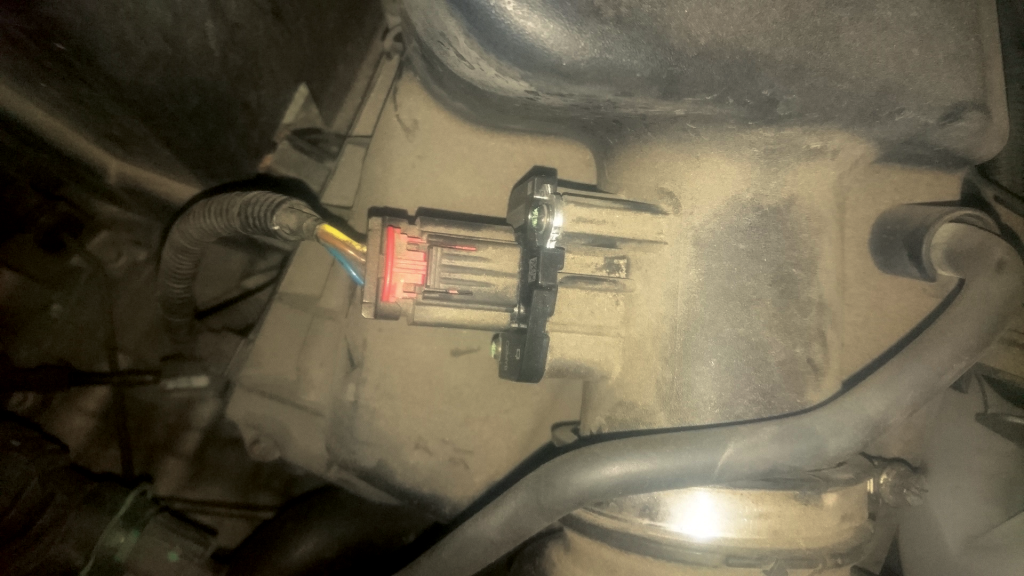
We connected the machine directly after the nice shiny new mass airflow sensor (See Image 1 and Image 2), and within a matter of seconds we could see smoke coming from the intercooler area. A closer inspection revealed a split in the intercooler hose. A new hose was fitted and the vehicle was retested which verified a successful repair. I would love to be writing all about measurements taken with oscilloscopes and lots of technical stuff but it simply wasn’t necessary here.
Could the previous garage have fixed this one (see Image 3)? More than likely, yes! A thorough visual inspection to the induction system would have revealed it without the smoke machine due to the amount of oil residue around the hose.
Experience
The clue was in the DTC all along – ‘Air Flow Too High.’ It could mean that the air flow sensor is faulty and is reading too high but it’s important to stop and consider what could make the reading too high. In this case simply too much air flowing through it because it’s leaking back out the other side. Experience gives you the understanding of the PCM’s logic in what would make it flag that fault code. It’s also a fair point to ask why the DTC said “boost pressure too low.”
Experience has taught us that different manufacturers have different ways of saying the same thing and that is why I emphasise on reading the fault code carefully. For the same symptom some manufactures may use the fault code text ‘boost pressure too low,’ ‘boost pressure negative deviation,’ ‘turbine under-speed,’ the list goes on but this one: MAF/MAP correlation incorrect”’(seen on Land Rover) hits the nail on the head! The logic within the PCM relies on tables of pre-set data for comparison. It knows that if the engine speed ‘X,’ if the air mass entering the engine is ‘Y’ then the manifold pressure should be ‘Z.’ There is a set error tolerance either side to allow for slight deviation and when this is exceeded. For example, when air is passing through the mass airflow sensor but escaping before the manifold, then the DTC is set and as in most pressure related faults the engine power is reduced (see image 4).