


Ride the common rail
 10 August 2022
A 2016 Nissan NV300 with the 1.6L common rail diesel Injection engine (R9M) had a clutch and flywheel replaced due to general wear and tear. There was a judder evident through the clutch pedal when releasing the clutch and a loud rumble could be heard from the transmission when starting and switching off the engine.
The transmission and clutch assembly were removed and the dual mass flywheel (DMF) inspected. Both rotational travel and bearing axial load was measured. The axial load was less than 1mm however the rotational travel of the secondary mass with respect to the primary mass exceeded 15 degrees of rotation. This indicated the arc springs were excessively worn. Please refer to thee sectioned view of a DMF as seen in Fig.1.
Once the flywheel and clutch assembly was replaced the engine was cranked over but failed to start. The following fault code was retrieved from the engine management system: DF003 – Camshaft/engine speed sensor consistency’.
This indicated an issue with the relationship between the camshaft position and crankshaft position. It should also be noted that the fault code cleared with the key on, engine off. This was an indication that the issue is only present when the engine is cranking. Normally a wiring fault will not clear or the code will return once the ignition is cycled.
1) Primary Mass.
2) Secondary Mass.
3) Centre Bearing.
4) Arc Springs.
5) Torsional Springs.
As this engine has a phonic wheel form crankshaft position on the flywheel, it was prudent to start with a Cam/Crank relationship test using the oscilloscope.
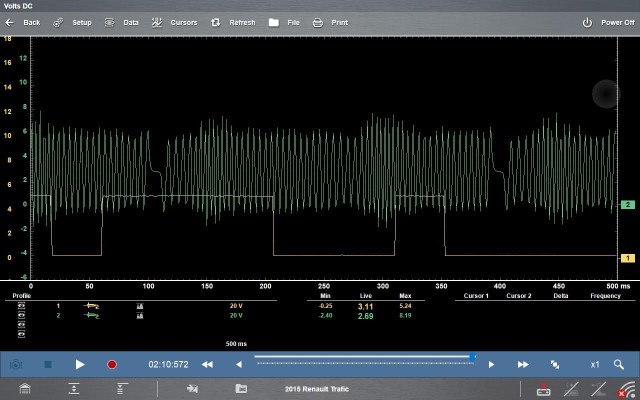
A waveform was captured from the vehicle with the starting concern and compared to a known good vehicle.
Fig.2 and Fig.3 show the waveform for both vehicles. Fig.2 shows the pattern from a vehicle known to be good, while Fig.3 shows one known to be faulty. Yellow trace; Camshaft position sensor. Green trace; Crankshaft position sensor.
NB: It must be noted that the amplitude and frequency of the traces will vary depending on whether the engine is cranking (no start condition) or idling. This is acceptable for this engine as it doesn’t have variable valve timing. Engines with variable valve timing should be assessed under the same operating conditions.
Closer inspection of the waveform shows a difference of 9 teeth. As there are 58 (plus two missing) teeth on the flywheel, each tooth represents 9°of crankshaft rotation. This equates to a difference of 54° of crankshaft rotation.
Note; On this vehicle the crankshaft position sensor is inductive and the camshaft position sensor is Hall Effect. Please refer to Fig.4, the known good vehicle. Then refer to Fig.5, showing the faulty vehicle.
Removal
The Transmission, clutch assembly and flywheel were again removed to inspect this alignment of the flywheel. The alignment of the flywheel is a concern as this engine doesn’t have a locating dowel to align the flywheel.
A reference hole which must line up with a reference hole on the rear flange of the crankshaft. Once the flywheel was correctly aligned and the vehicle re-assembled the fault code cleared and the engine started and operated as expected.