


When one diagnostic tool isn’t enough
 16 October 2026
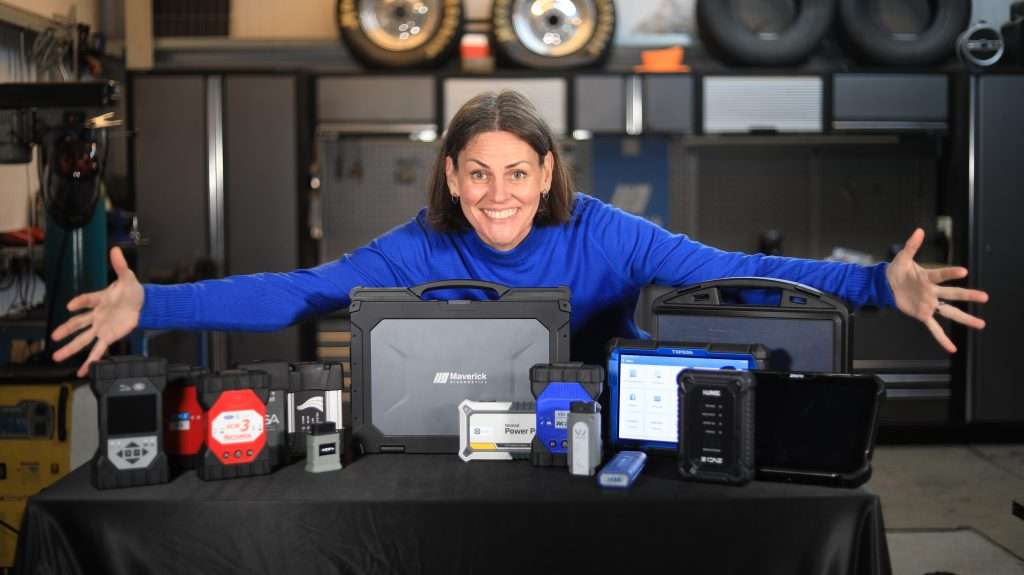
Laura Hall, Managing Director at Maverick Diagnostics, explains why increasingly complex vehicles mean independent workshops may need to look beyond a single diagnostic platform and how combining aftermarket, OEM and pass-thru tools can help garages keep more work in-house.
Modern aftermarket diagnostic tools are more capable than ever. A good multi-brand platform can provide extensive vehicle coverage, fast system scans, service functions, live data, actuator tests and, in some cases, coding and programming.
However, no single diagnostic tool covers every manufacturer, model and function to the same depth. For workshops facing an increasingly complex vehicle parc, the question is no longer simply, “Which tool should we buy?” It is, “Which combination of tools will allow us to complete the work we want to keep in-house?”
Coverage does not always mean capability
A vehicle appearing on a tool’s coverage list does not necessarily mean that every function is available.
One platform might communicate with all the control modules on a vehicle but offer limited coding or programming. Another might provide excellent component testing but struggle with a manufacturer’s secure gateway. Even coverage can vary between different models, model years and powertrains from the same manufacturer.
Workshops therefore need to look beyond the number of manufacturers shown in the brochure. The more useful questions are:
- Can it access the systems we regularly work on?
- Does it support bidirectional controls and component activation?
- Can it perform the adaptations, calibrations and resets we need?
- Does it provide secure gateway access?
- Can it carry out coding, programming and security-related functions?
- What happens when the tool cannot complete a particular job?
The phrase “dealer-level” is also used widely within the diagnostic market, but it does not always mean full manufacturer-level functionality. It may refer to the depth of general diagnostics available rather than providing access to every guided test, programming process or online function offered by the manufacturer’s own system.
Aftermarket tools provide breadth
For most independent garages, a capable multi-make aftermarket tool remains the most practical starting point.
It lets technicians work across a wide range of vehicles without buying separate hardware and software for every brand. This makes it ideal for everyday diagnostics, servicing, fault-code reading, live data, testing and common repair procedures.
Different platforms have different strengths. Some offer particularly good European coverage or secure gateway access, while others perform well with Asian vehicles, topology mapping, EV systems, component testing or advanced programming functions.
This is why there is no universal “best” aftermarket tool. Autocom, XTOOL, Zenith, Topdon, Autel and other platforms can all be strong choices, but their suitability depends on the workshop’s vehicle mix and the work it wants to undertake.
The right aftermarket tool can substantially reduce the number of jobs being turned away or subcontracted. Nevertheless, it should not automatically be viewed as a complete replacement for every manufacturer’s diagnostic system.
When OEM tools become worthwhile
OEM tools offer depth rather than breadth. Systems such as BMW ISTA, Mercedes-Benz XENTRY, VAG ODIS, Ford FDRS and Stellantis WiTECH are developed for their respective manufacturer networks.
They provide access to manufacturer-specific procedures, guided diagnostics, software updates, online coding, programming, and other functions that a multi-brand platform may not fully support.
For a general workshop that sees a particular marque occasionally, investing in its OEM system may not be commercially justified. However, the calculation changes when a workshop specialises in a brand or regularly sends profitable work elsewhere because their existing tool is missing the required functionality.
The purchase price of the interface is only part of the decision. Workshops must also consider software subscriptions, account registration, security requirements, compatible laptops, updates, training and the time required to keep the system working correctly.
An OEM tool can add valuable capability, but only when the workshop has the vehicle volume, technician knowledge, and support needed to use it effectively.
Where pass-thru fits
Pass-thru provides a useful middle ground between multi-make diagnostics and purchasing a genuine interface for every manufacturer.
An approved J2534 interface can allow a workshop to use certain manufacturer software without having to invest in the OEM hardware package for one brand. This can be a cost-effective way to handle occasional manufacturer-level work or to test whether there is sufficient demand to justify investing in a dedicated system.
However, pass-thru capability varies between manufacturers. Access to diagnostics, coding, and programming depends on the individual OEM platform, not the interface alone.
Pass-thru can work particularly well for occasional diagnostics, but regular programming may be slower or less straightforward than using the manufacturer’s genuine VCI. If a workshop frequently programs vehicles from one brand, the genuine interface will often provide a more efficient and reliable long-term solution.
Building the right diagnostic set-up
For many workshops, the most realistic answer is a combination:
- A professional aftermarket tool for everyday multi-brand work.
- Selected OEM systems for the manufacturers the workshop sees most frequently.
- Pass-thru access for occasional dealer-level requirements.
- Specialist equipment for tasks such as oscilloscope testing, battery diagnostics, ADAS calibration or key programming.
This does not mean every garage needs to buy multiple dealer tools immediately, as the investment should follow the work.
Workshops should look at which vehicles they see most often, which jobs they currently outsource, and where diagnostic limitations cost them time or revenue. From there, they can add capability in a measured way, starting with the areas that offer the clearest return.
Ultimately, the aim is not to own the most tools. It is to have the right combination of equipment, software, technical support and training to diagnose vehicles accurately and complete more work successfully.
One tool may provide an excellent foundation. Increasingly, however, the most capable independent workshops are building a diagnostic strategy rather than relying on a single platform.
Click here for more information