


Rue de Qualite
 7 November 2017
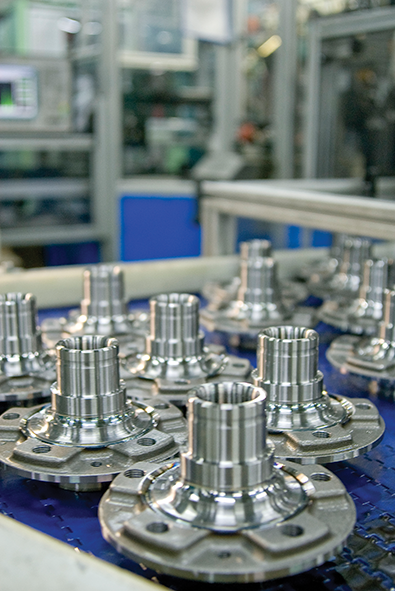
This month I have chosen a subject from a recent visit to NTN SNR at their Annecy plants in the Rhone alps region of France.
Last week found me at Lyon airport, thankfully not with Ryanair. There are seven plants, if my memory serves me correctly. It is a proud French company with global facilities in the far east, central Europe and the Americas. Their adopted company language is English- so much for Brexit and ill feelings. Take it from me it does not exist, except in the minds of the idiots we call politicians.
The company produces a huge range of bearings for a cross section of transport segments such as light vehicle and public transport. This includes the incredible demands of the TGV, commercial vehicles, and earth moving plant and aerospace such as Airbus and others.
This subject I hope, brings some reality into what is often expressed as an emotive opinion without substance or fact-based evidence.
OE Vs. Copy
This visit should provide some clarity on the age-old question: Are original equipment parts superior to patent copies? The raw material high grade steel is sourced from carefully selected suppliers, with documentation supporting thorough batch testing, for grain density, and molecular content. I witnessed the heat treatment and initial forging of a range of bearings and housings from generation one through generation three. This was followed by a series of machining processes forming the hub, flange and bearing shells. One very interesting feature of the flange manufacture is a relief groove onto which the brake disc is mounted. Without this feature it is not possible for the brake disc to run true. How many hub flanges have you fitted with a solid face flange? The flange is then further machined to reduce unstrung mass.
Once the hub and bearing components pass to the automated assembly plant each process was meticulously checked, the unique tooling is designed and built by NTN SNR in house. The grease, once applied to each side of the bearing assembly, was then weighed ensuring the correct applied quantity. The bearing was then run at speed monitoring vibration with an accelerometer. It is not possible for a bearing assembly to leave this stage of production with excessive noise
or vibration.
Any bearing assembly failing this stringent testing regime was automatically redirected off the production run. Finally, the finished bearing was then subject to the correct clamping torque and load stresses to check the running clearances. This was measured in microns. The bearing seal friction has been developed to reduce fuel consumption. The final assembly function involved fitting the encoder disc, and yes, the magnetic field was meticulously tested for field density.
A quick word of advice here: Several bearings have been returned to their test and warranty lab. The cause was mechanics placing the new bearings in magnetic parts trays prior to fitment. This will permanently destroy the encoder disc. It is also of note that the bearing fitted with an ASB encoder was patented by NTN SNR. The magnetic encoder is now directionally sensitive for hill start and other advanced chassis control applications. I also was privileged to view test cells where vehicle and wind turbine gearboxes were being put through rigorous stress testing. This area is extremely sensitive so not too much detail here, and sadly, no photography available.
Easily identified
So, why is it not possible for an independent manufacturer to simply copy O/E component?
- No access to the metallurgy specifications
- No access to the drawings and load specifications
- Inability to test to the correct specification
- Cost constraints driven by lower pricing and quality
- Copyright and production secrecy
Put simply, copy parts made for cost reduction cannot reproduce the original specifications.
Sadly, like many things in life I was shown a selection of counterfeit bearings these were easily identified due to the incorrect production coding ID, this is also a guarded secret.
Incredible insight
It was an incredible insight into something we all take for granted. The simple wheel bearing is clearly not so simple any more. I can confirm from their test and returns facility that in many cases bearings are not being fitted correctly, and correct tooling is not being used by technicians. The biggest cause of premature failure is due to incorrect torque of the bearing to housing. This affects the running clearance specification.
The last and final observation is on the friendly atmosphere and dedication of the workforce. Production staff were rotated on a shift system maintaining interest and a proud dedication to their products.
Just in case you were wondering what the difference in production quality or technique is between OE and aftermarket supply? One very small stamp in the casting which identifies the VM brand. We at ADS have been convinced of quality over price for many years, I hope this story helps you understand why.