


Test, don’t just experiment
 28 June 2013
By Andy Crook
? P0190 Rail Pressure Sensor Circuit
? P1458 Coolant Solenoid Valve
? P0380 Pre-Heating Relay Circuit
? P1425 AC Relay Circuit Malfunction
When a vehicle is presented with multiple codes it is always worth considering the importance of the inputs to the ECU. During training courses we focus on identifying where the primary sensors are and what they do. These are the inputs that are required to allow the engine to start or run correctly.
I can’t emphasise enough that knowing what the reading should be before taking the measurement is a requirement of testing. If you don’t know what it should be then you are experimenting, not testing. In this case, the readings should be 0.5V and 0.1V respectively. The next step is to test the wiring back to the ECU pins; all was OK, there were no shorts or open circuits. This suggests the problem is in the ECU. To prove the fault, I provided the rail pressure sensor with a temporary earth direct to the battery and cleared the codes. The ECU registered normal rail pressure during cranking and the engine fired into life. After a brief test drive the engine suddenly cut out. It was time to check the DTCs again. On this occasion I got the following codes:
? P0380 Glow Plug/Heater Circuit ‘A’ Malfunction.
? P1112 Diesel high pressure monitoring system Malfunction.
? P1465 A/C Relay circuit malfunction
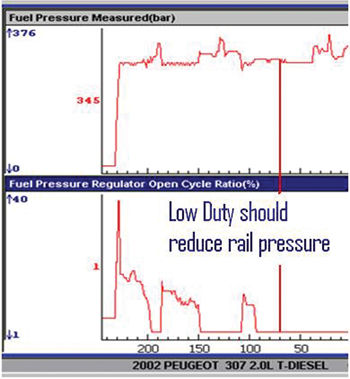
It was the fuel pressure monitoring code that had caused the engine to cut out. I cleared the codes and started the engine again, the rail pressure rose as expected during cranking then settled to around 360 bar then climbed towards 400 bar and the engine stalled.
Removing the control current from the regulator should result in 50-80 bar of pressure, due to the force of the spring inside the pressure regulator. This will prove the sensor is reading correctly. A simple test is to compare rail pressure with the regulator current – the two should follow each other closely. This can be performed using an oscilloscope as shown in the diagram.